A data-driven senior + caregiver health alert system designed to detect changes in a senior’s health before they become an emergency.
-
Situation
The percentage of seniors and caregivers in the US is steadily growing. In 2019, the senior population size was about 54.1M (16% of the US population). By 2040, the senior population is projected to be about 80.8M (25% of the US population). The percentage of caregivers is also growing with about 1 in 6 Americans being caregivers for someone 50+ years old with about 89% of caretakers taking care of a relative.
Today, family members of seniors are worried about changes in their senior’s health that they might only notice if they were living together such as shifts in daily routines, changes in gait, mobility, or difficulty sleeping. They want more contextual health data that can inform them on the overall health of their senior, including the ability to reference any changes in health should they have concerns.
-
Complication
Changes in senior health can be difficult to detect for family members looking after seniors who want to live independently longer without assisted living. Many senior health crises start with a smaller, more progressive decline — like a drop in daily movement, changes in routine and cognitive ability.
Wearable device biometric data capture, combined with the latest in AI, can identify and highlight these critical changes which can be effectively used to identify changes over time. Neither family members nor seniors can do this currently because the senior health alert market is focused on either sudden, reactive care, that provides medical alerts for falls or other acute events that enable them to contact 911.
Additionally, while brand-name wearable fitness trackers have basic health alerts and dashboards, as well as fall detection that enables SOS alerts, they are not catered specifically to the senior market and are instead primarily aimed at fitness and health enthusiasts.
-
Resolution
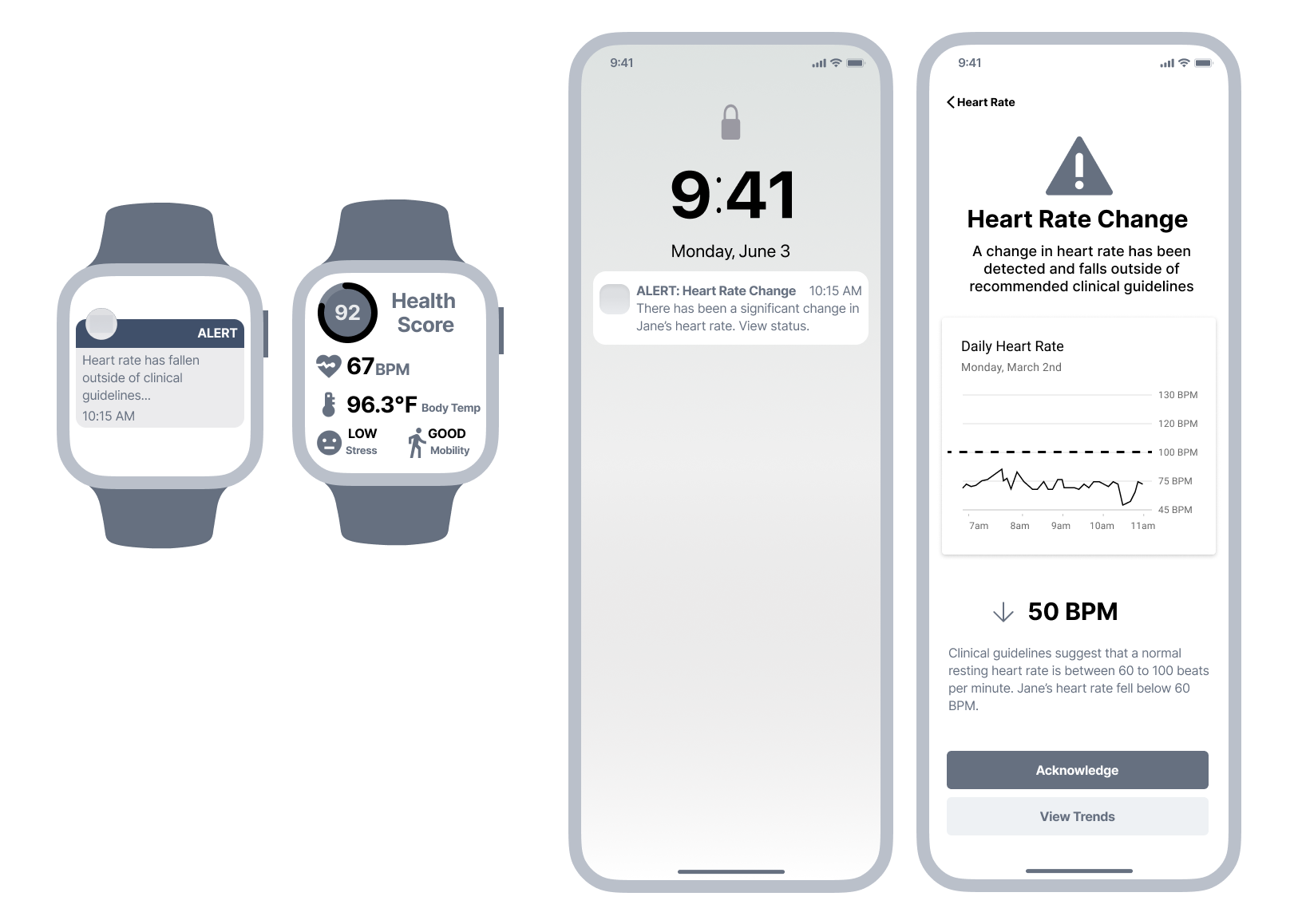
Create an AI-powered platform to provide early detection of senior health issues by monitoring and analyzing changes in health via a smartwatch which will deliver timely mobile health alerts enabling family members to be proactive and informed in identifying and addressing emerging health risks before they become an emergency.
We can help seniors live independently longer.
How might we provide insights to a senior’s health and keep their caregiver(s) informed so they can be proactive in identifying and addressing emerging health risks before they become an emergency and drastically altering the senior’s life?
This project focused on testing the desirability of a new concept in order to:
Determine if our solution was a nice to have or a must have for customers.
Understand the key pain points and opportunities for seniors and their caregivers.
Determine if we were solving for the right customer needs.
For this project I partnered with another designer and 3 product owners. Over the course of 6 weeks, we worked in 2 week sprint increments. Design activities included:
Defining a design statement and design principles.
Storyboarding with internal clients to align on the future vision of the product.
External user research (qualitative interviews with 4 seniors and 6 caregivers, card sorting activities and wireframe concept testing).
Creating a shareable readout to further socialize the new concept with additional internal stakeholders.
The Design Process
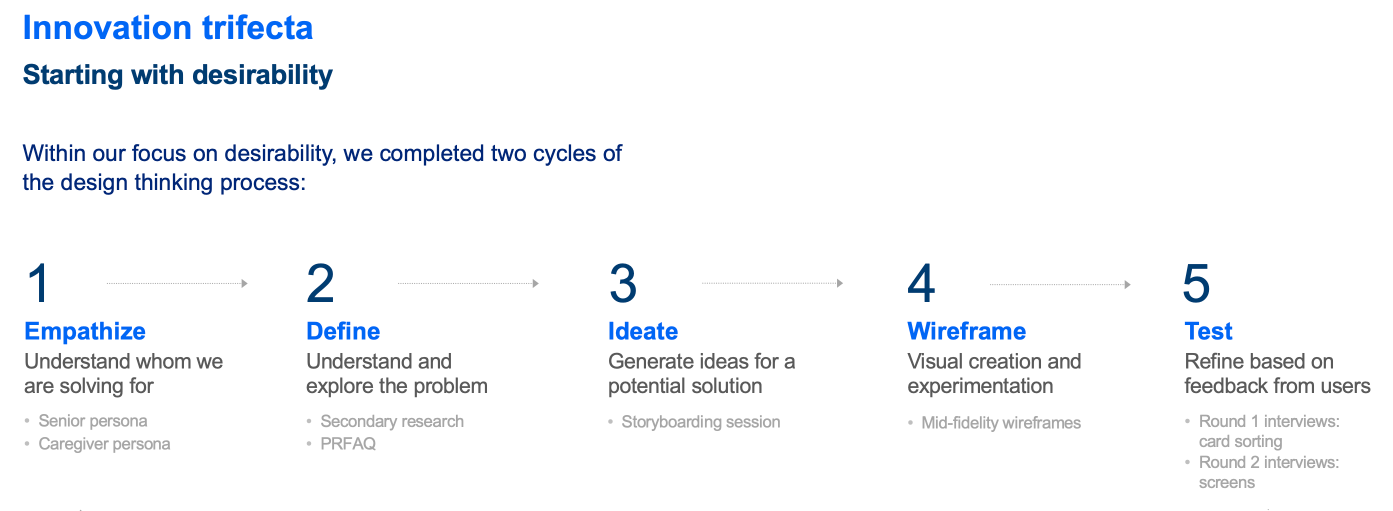
*A Press Release and FAQ (PRFAQ) is an innovation methodology originally developed by Amazon. Typically, it is a six page document that is crafted during product development to envision the product's launch, outlining features, benefits, and problem-solving capabilities. The press release communicates the product's essence compellingly, while the FAQ addresses potential internal and external questions.
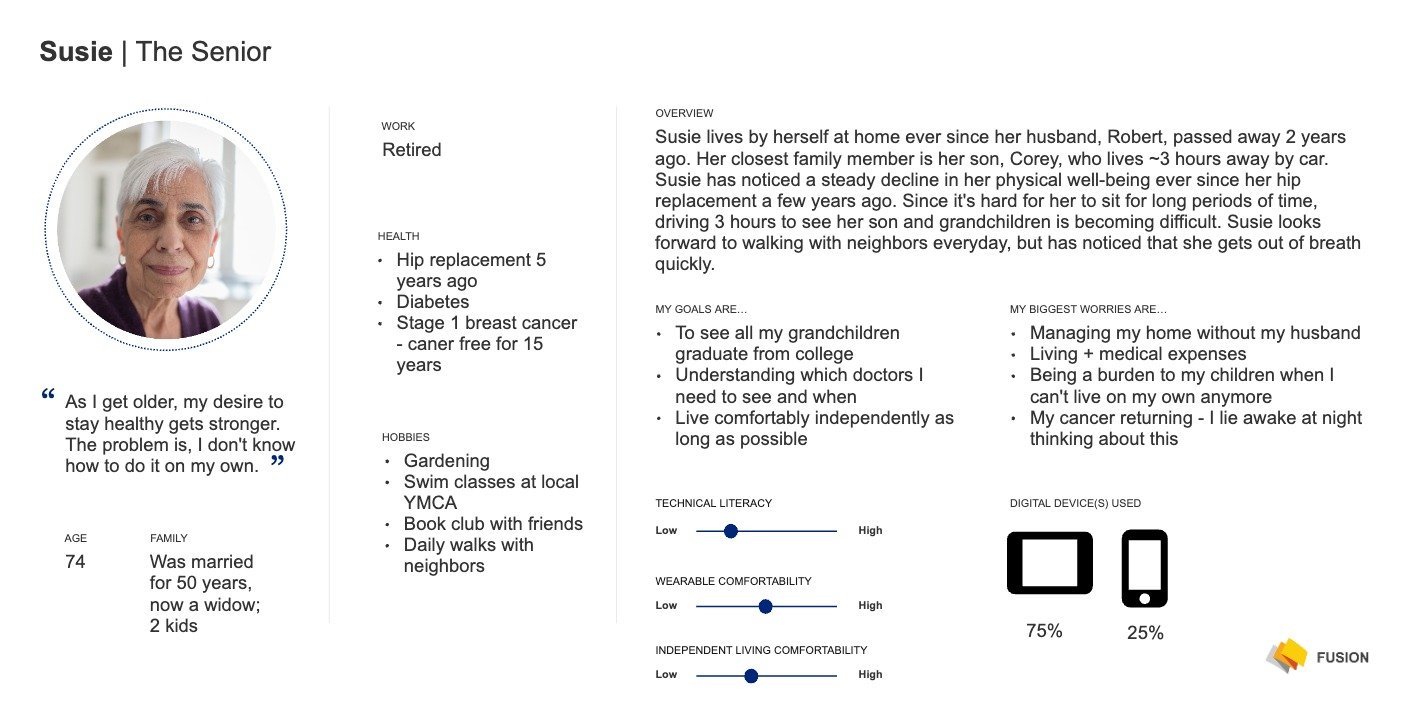
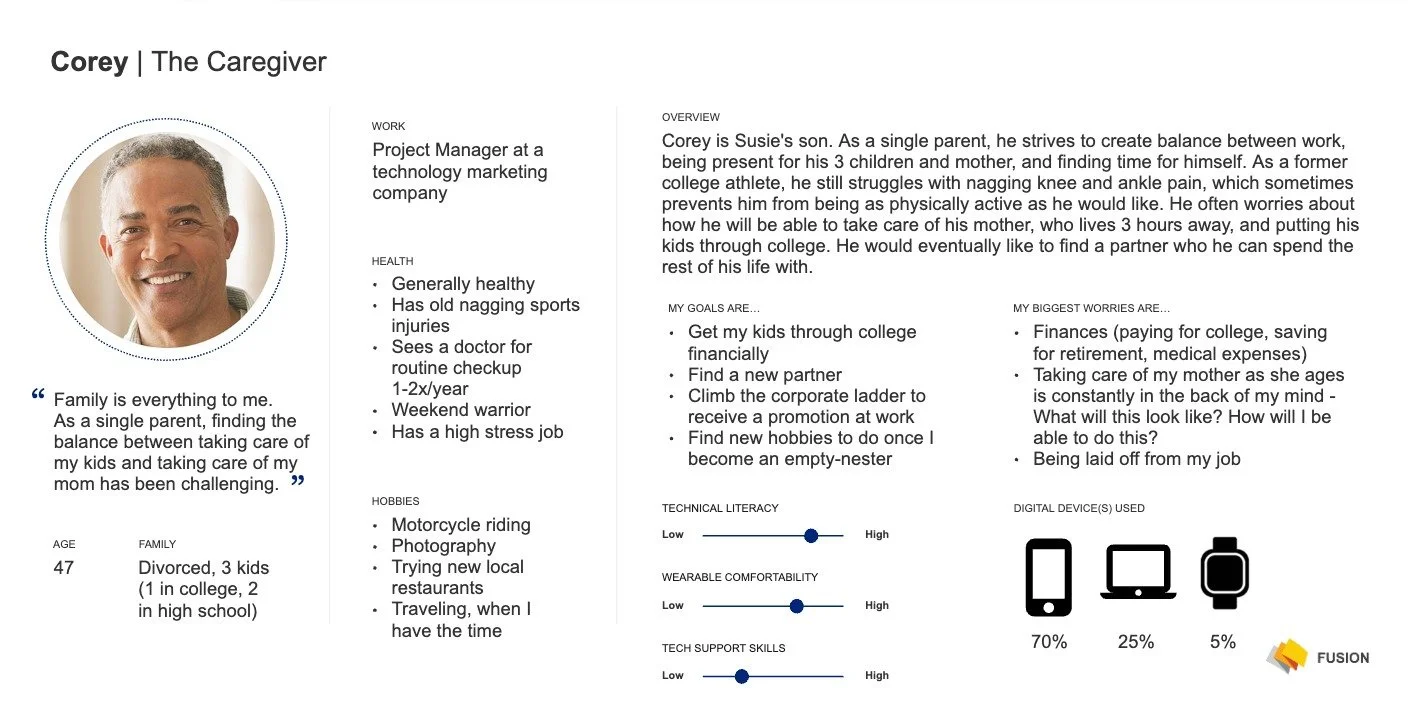
Personas
To understand the current state, we empathized and defined our target personas: seniors and caregivers.
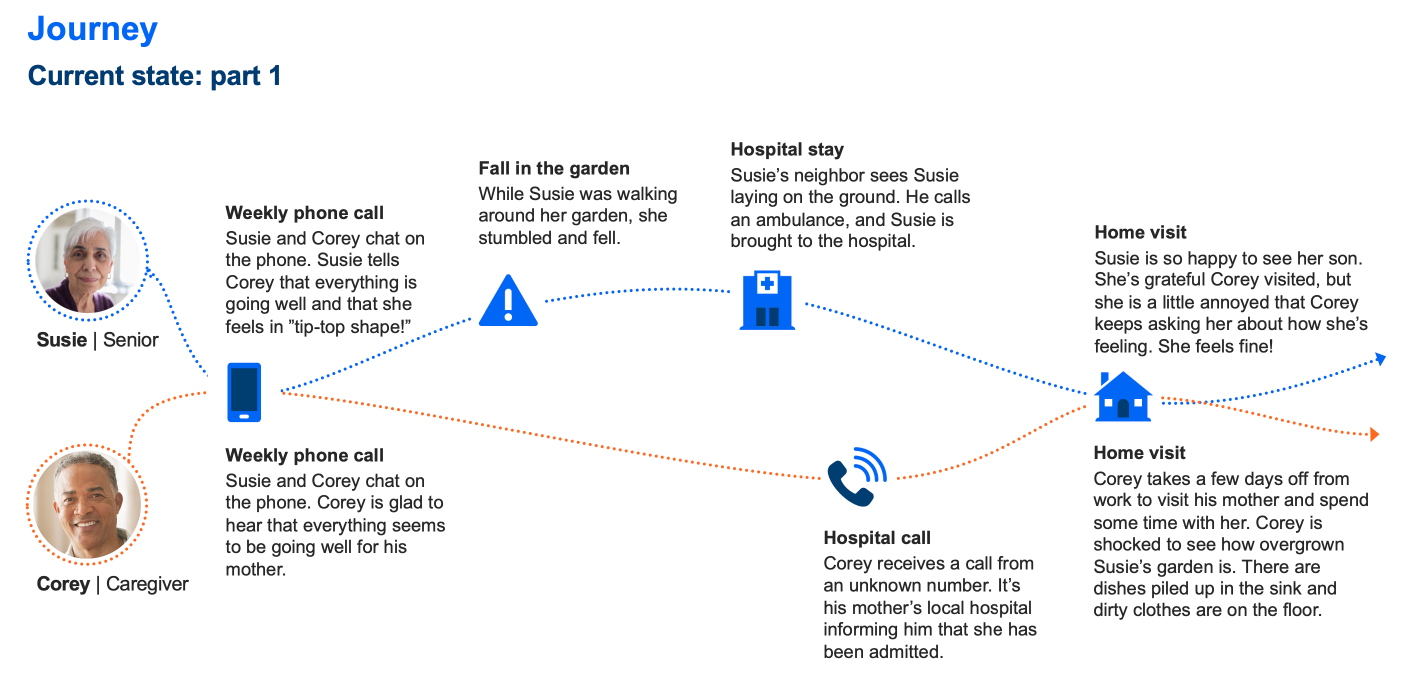
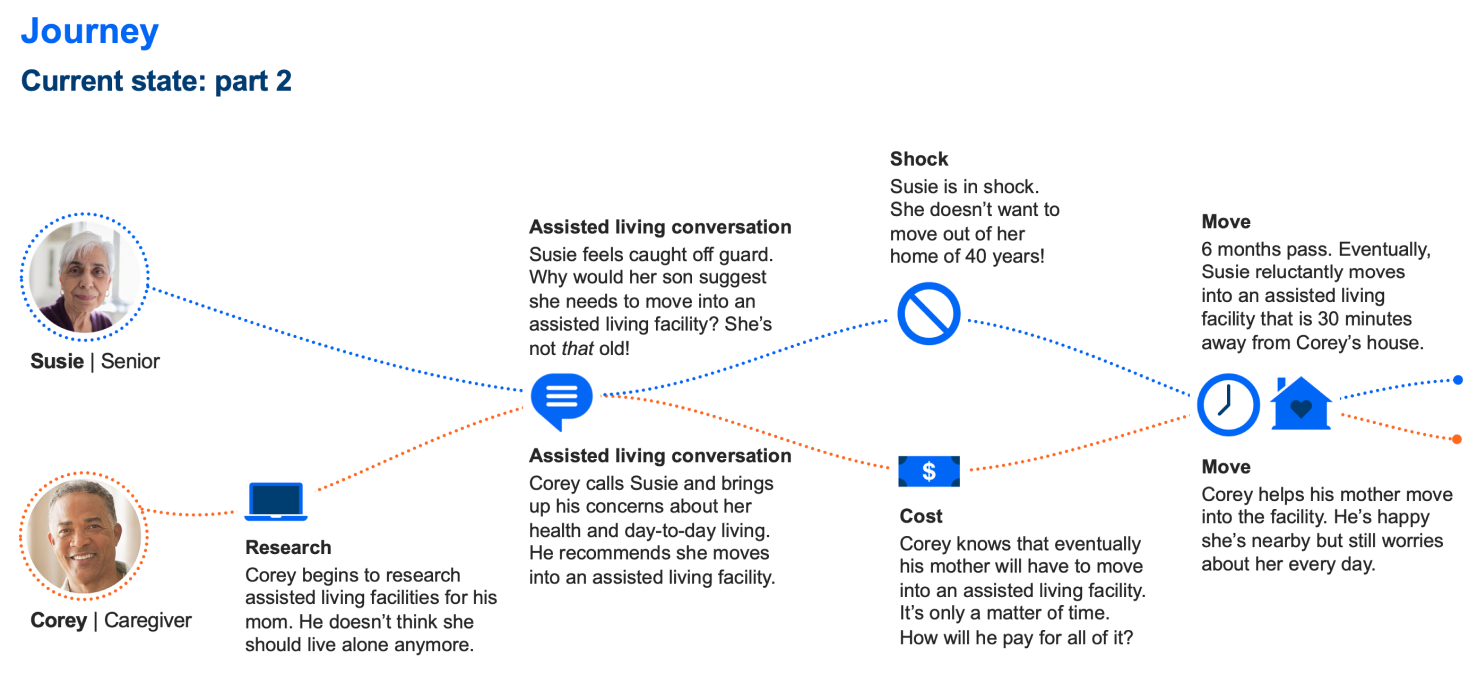
Current State Journey
In the current state journey, neither Susie nor Corey have access to the senior health alert system. This journey outlines some of the pain points they both experience.
Design Statement and Design Principles
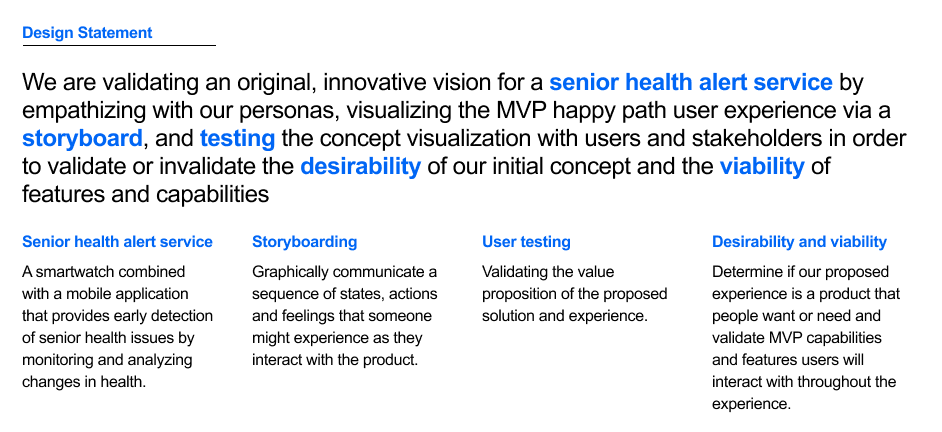
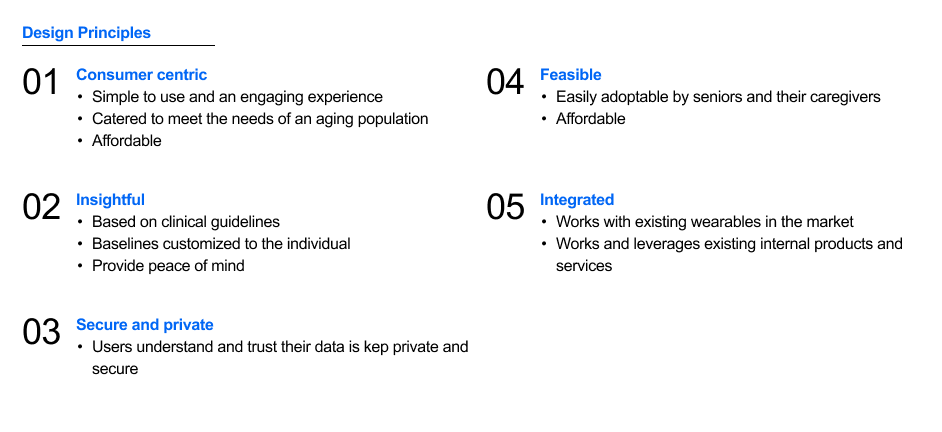
The design statement served as our North Star and our guiding light for what we wanted to achieve throughout the project. The design principles served as our guardrails and our decision making tools for the product experience and design solution. We defined and aligned on the design statement and design principles with our internal clients.
Storyboarding
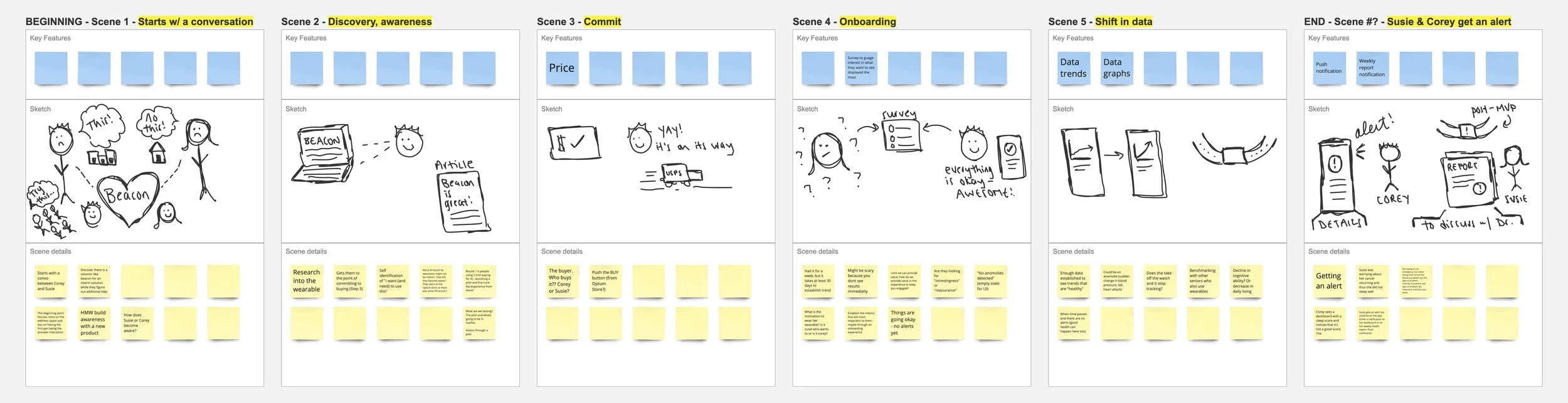
After defining our personas, current state journey map, design statement and design principles, we worked together with the the internal product management team, to further define their vision for the senior health alert product through a storyboarding activity. We asked each member of the product team to sketch their version of the story and how they envisioned the product being used while capturing the personas thoughts, feelings and emotions.
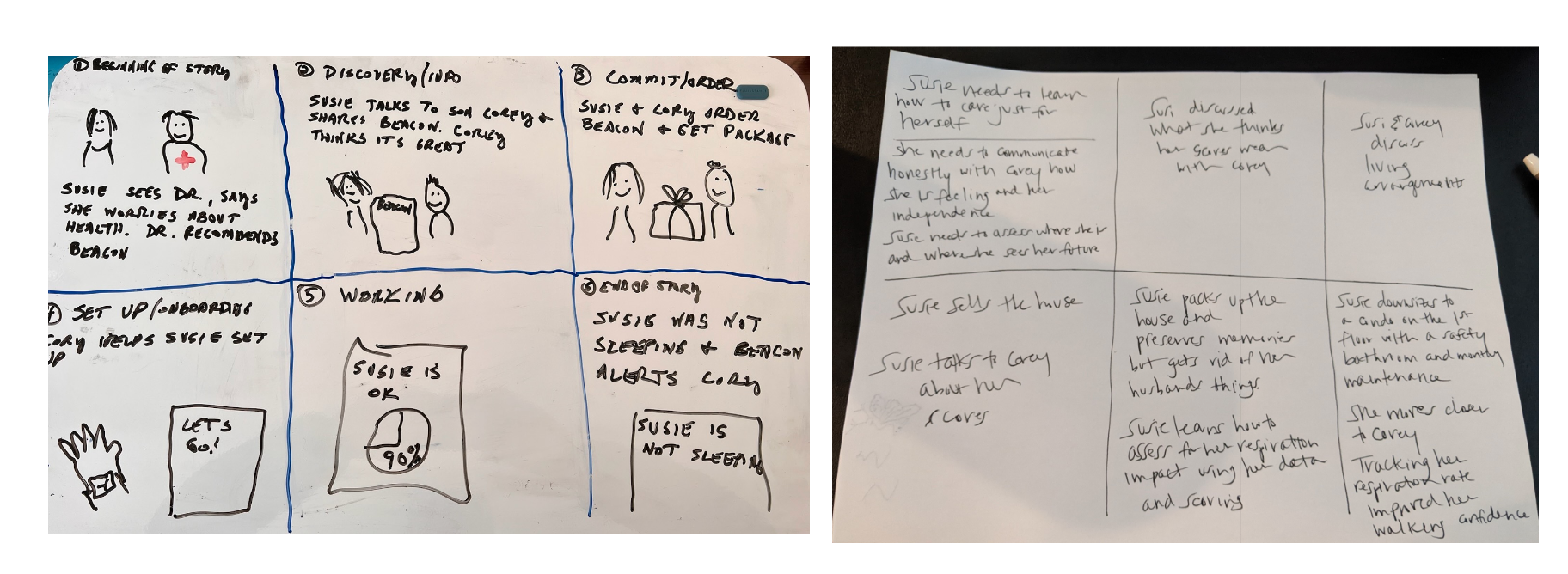
After individually sketching, we aligned on one future vision that we would further test in user interviews.
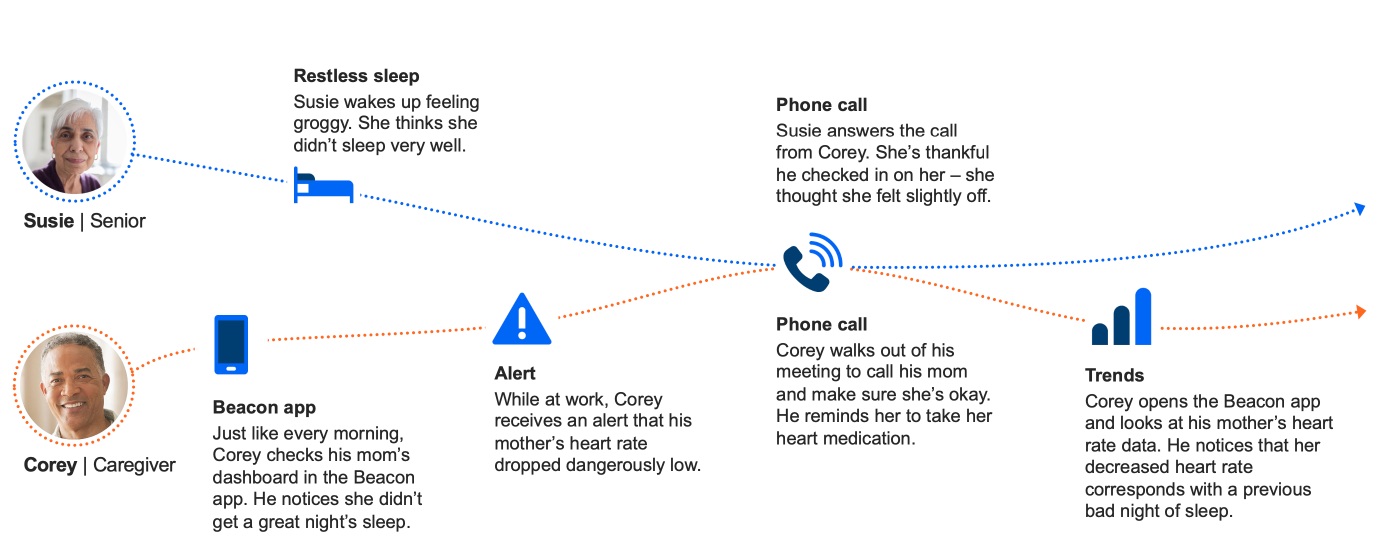
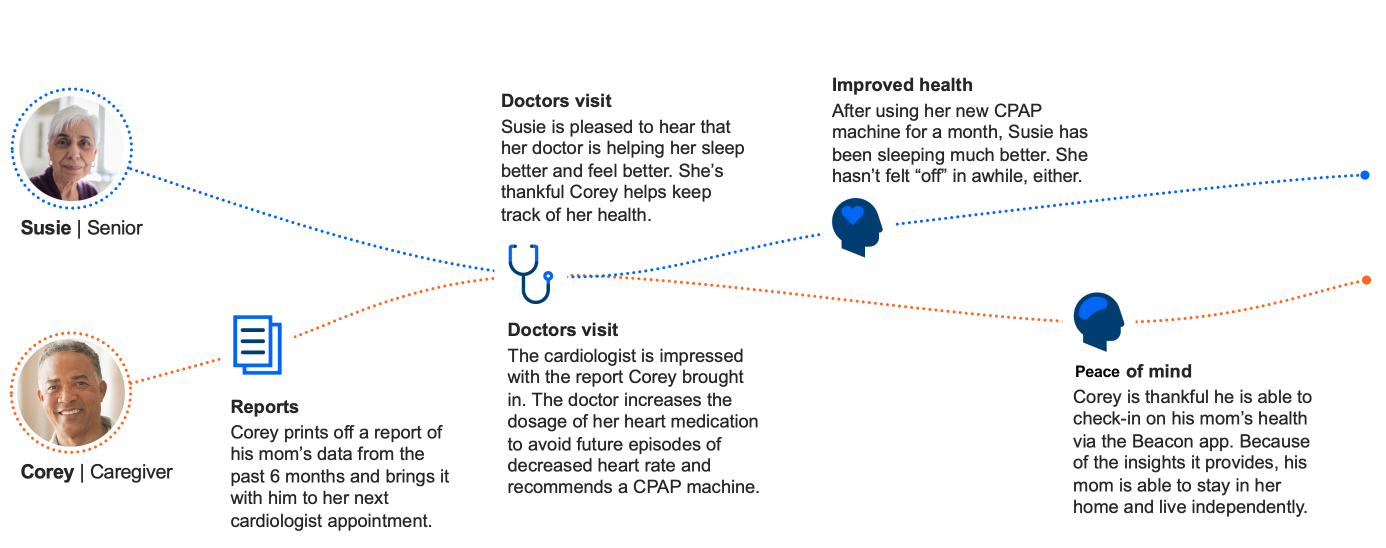
Future state journey map
Based on the storyboarding activity, we created a future state journey map that we would further validate or invalidate during our user research.
User research: Qualitative interviews
During round 1 of our user research, we conducted qualitative interviews with 4 seniors and 6 caregivers.
Interview questions: Senior
Current health
How would you describe your current health and wellness?
Caregiver relationship
Tell us about your caregiver - what is your relationship with them? What role do they play in your life? Do they live near you?
Daily living
Think about a time when you had to complete daily living activities. Walk me through your day to day routine.
Pain points
Do you experience any pain points, challenges or barriers with your daily living activities?
Do you need support or help with any specific activities?
Future health
As you think about your future health and continuing to live independently, what worries or concerns do you have? What would alleviate those concerns?
Technology
Tell me about a time when you used technology to understand your health. How did you interact with that technology?
Interview questions: Caregiver
Current health
How would you describe your senior’s current health and wellness?
Senior relationship
Describe your relationship with your senior. How often do you check-in on them? How do you currently support your senior’s health?
Technology
Do you use technology to support your senior’s health? Tell us about that experience.
Health decisions
How would you describe your ability to explain tech to your parents?
Pain points
As you think about your senior’s future and them continuing to live independently, what worries or concerns do you have?
Future health
How would you improve or change their living situation? What would alleviate your pain points/concerns?
What information would be helpful to have when it comes to making decisions about your senior’s health?
Key insights from user interviews
Key insights: Senior
Current health
Seniors feel that their current health has been on the decline; they experience chronic conditions such as high blood pressure, sleep apnea, hearing decline, and cataracts.
Seniors experience limited physical mobility due to other health conditions such as knee replacements or being overweight; climbing steps is challenging for seniors.
Health conditions, limitations, and conditions may pop-up on a day-to-day basis - this makes it difficult for seniors to predict what tomorrow will look like.
Caregiver relationship
Most senior caregivers are their children - typically one child is the primary caretaker while other children may provide additional, secondary support.
Family caregivers who are close with their seniors are more in-tune with the senior's health and needs; some seniors mentioned that they "edit" what information they tell or share with caregiver. Seniors who have a closer relationship to their caregivers seem to be more optimistic and informed about their health.
Some seniors have found a balance of independence and co-dependence with their caregivers, while other seniors struggle to come to terms with their declining health.
Future health
As seniors age, they become more stubborn in their beliefs (E.g.: a 68 year-old who resists support in managing their health and takes pride in living independently will likely become more and more resistant as they age. E.g.: a 68 year-old who is open to leveraging technology and others' support in managing their care will likely be more open to using new tools and receiving more care support as they age).
In general, there are concerns about the unknown as it relates to seniors declining health; seniors face having to manage conditions as they come up (e.g.: the flu, gout, or an accident such as falling).
Technology
The seniors we spoke with frequently use a tablet and phone for things such as communicating with others, gathering information (keeping up with the news, researching health concerns) and entertainment (watching shows, playing games)
Based on senior and caregiver conversations, there is a sliding scale of how comfortable seniors are with leveraging and embracing technology
Seniors have a wearable such as Fitbit, Samsung watch, and Apple watch; some seniors prefer a smartwatch over the Fitbit because it has more capabilities and features (such as EKG readings)
An app that was frequently used was My Fitness Pal to track food intake and record weight loss
Key insights: Caregiver
Current health
Top current health observations included Alzheimer's, dementia, mental health issues, diabetes, declining eye sight, poor mobility, and heart health issues.
Caregivers often feel overwhelmed by responsibility; it is difficult trying to balance taking care of their seniors while enabling them to live as independently as possible - all while balancing their own (the caregiver's) health, their household family's health, etc. Navigating their senior's health insurance is time consuming and overwhelming.
Caregivers wish they had more knowledge in certain legal and medical subjects such as becoming a Power of Attorney, selling a home, managing debt, or better understanding medical conditions.
Senior relationship
The caregivers that seem to have the strongest/closest relationship with their senior are those who have additional support - whether it be from other family members or hired help (e.g., in-house nurse).
The initial responsibilities caregivers take on are: managing doctor's appointments, medications, helping with daily living tasks, and financials. Caregiver responsibilities increase as senior health declines.
Overall, caregivers have daily interaction with their senior - whether it be in-house visits, calls, texts, etc.
Future health
Caregivers are concerned about their seniors health continuing to decline and their ability to continue living independently; they fear not being around or available when a major event happens.
Caregivers worry about medical bills and finding a reputable and quality living facility that still enables the caregivers to remain close by.
Caregivers would like to have more information about their senior's medical history so they can be better informed about health decisions they might have to make.
Health decisions
If caregivers want more information in order to make better decisions regarding their senior's health, it is up to the caregiver themselves to take on the responsibility of researching and gathering information.
Caregivers complete independent research via the internet to better understand their senior's condition and to help them decide the best course of action. Secondary resources include books and speaking with friends who are also caregivers. Caregivers researched topics such as vaccine side effects and benefits of surgeries recommended by doctors.
Technology
Caregivers use technology primarily to communicate with their seniors, manage doctor's appointments and medications, and conduct remote video monitoring.
Some caregivers mentioned their senior was not open to using a smartphone or additional technology such as a wearable, and if fact, the senior would refuse to wear any type of wearable.
User research: Card sorting
After conducting qualitative interviews, we asked both seniors and caregivers to complete a card sorting activity via Miro to prioritize features and capabilities that would be desirable to them. The features and capabilities we tested were based on the product manager’s PRFAQ document and the agreed upon MVP features during the storyboarding session. After completing the card sort activity, we created a heat map to visually analyze the results of the most desirable features.
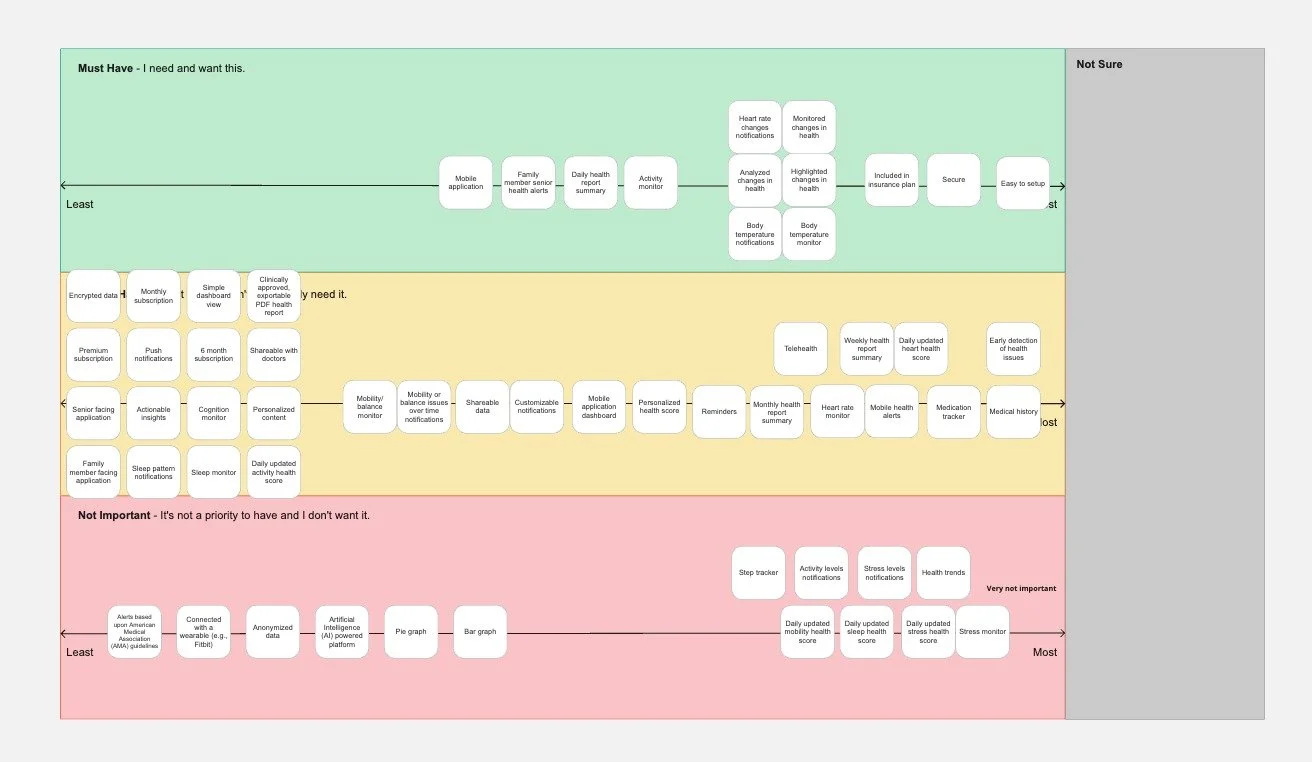
Example of a caregiver’s card sort activity responses
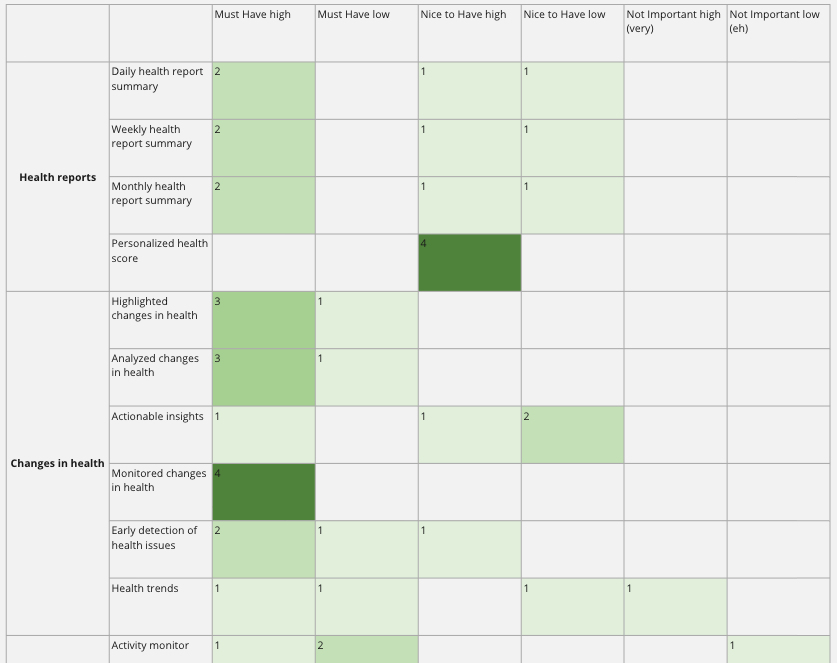
Heat map analysis of the most (and least) desirable features based on the card sort activity
Card sort insights
Key insights: Senior
Overall
The seniors we interviewed currently leverage some technology to help manage their health. There was a theme of statements such as, "I already have a heart rate monitor... I already track xyz-metric...".
Recommendation: the target market for this concept is on a sliding scale; seniors who embrace technology should be marketed to along with their caregivers; for seniors who do not embrace technology and whose cognition health is extremely poor, consider marketing more heavily to their caregivers.
Finances
Seniors were wary of a subscription model but were open to learning more about the different types of payment options that could be offered.
Biometrics
Some seniors found daily scores/metrics/reports to be too cumbersome; they leaned more heavily towards weekly or monthly scores/metrics/reports, as they wish to see their health progress over time.
Alerts
Seniors were open to the idea of having a family member alerted if something was wrong. Seniors consistently ranked "Alerts based on AMA guidelines" as a "Must Have" and "Nice to Have".
Capabilities
For each senior, the desired capabilities depended heavily on if they already have access to the capability. For example, seniors who wear a smart watch consistently did not desire having an additional heart rate tracker and step tracker. A "personalized health score" was ranked as a "Must Have" and "Nice to Have" feature.
Recommendation: Consider the value of the product being a "one-stop-shop" for seniors and caregivers alike regarding tracking and monitoring senior's day-to-day metrics.
Recommendation: there is an opportunity to educate users on the importance of health scores and to be explicit with how the scores are defined.
Key insights: Caregiver
Overall
Caregivers expressed high interest in the features and capabilities presented during the card sort. They felt it would be a valuable tool to help them take care of their senior loved ones. However, there were mixed opinions when it came to the wearable. Some caregivers said that their senior would never wear a wearable unless it was something that the senior didn't notice or even know about.
Finances
Most caregivers said it would be great if it was included in their insurance plan, but they would be open to a subscription model if they could experience a free month trial and then decide if they want to continue with the subscription. Some caregivers also mentioned they would want the wearable to be included with the app so they did not have to purchase an additional item.
Biometrics
The most desired biometric categories to be monitored and notified about were heart rate, body temperature, mobility/balance, and cognition. Note: some caregivers expressed confusion around how cognition would be measured. The least desired biometric categories to be monitored and notified about were activity, stress, and sleep.
Capabilities
Other top desirable capabilities included the ability to see highlighted and analyzed changes in health, early detection of health issues, being able to share the data with others (including doctors), and receiving alerts about their seniors.
Caregivers felt that daily, weekly and monthly health report summaries would be beneficial. However, some caregivers felt that receiving daily notifications would be too much.
Caregivers felt that a simple dashboard, being easy to setup, and a device that could provide reminders to the senior would be very desirable. The ability to track medication was also a desirable feature.
User research: Wireframe testing
We focused on the future state opportunity by utilizing the insights from the user interviews and card sort activity to visualize what the future state of the product concept would look like through a series of low-fidelity wireframes. We tested our wireframes during a second round of user interviews to gather reactions and further understand the impact that the experience could have on our personas.
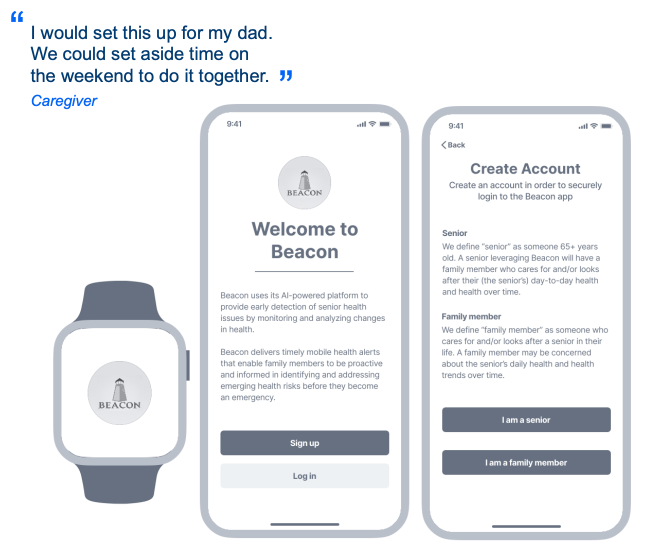
Key Insights
Onboarding and setup - opening the app for the first time
Set-up
Caregivers will likely help seniors pair the watch and set-up the app; another likely scenario is the caregiver will complete the set-up completely on their own and simply give the watch to the senior to wear.
Discoverability
Caregivers can imagine themselves telling their senior about this product.
Autonomy
Having a conversation about why the senior should wear the wearable will be an important step in getting them to wear it; it’s important for seniors to have autonomy over the decision to wear the wearable and see their health data if they want to.
Integration
Seniors who already leverage health technology will be more likely to purchase and engage with the product if it was integrated with technology they already have and use.
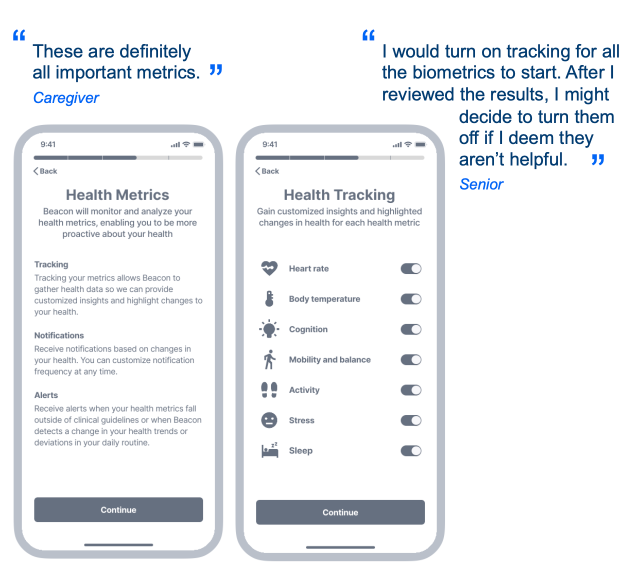
Key Insights
Onboarding and setup - toggling health biometric tracking
Tracking preferences
When setting up the application, most seniors will track all the biometrics to start and turn them off as they determine if the data was accurate or beneficial to them.
Biometric curiosity
Seniors are interested in how balance, stress, and cognition would be measured – both seniors and caregivers emphasized the importance of understanding how biometrics are measured.
Key Insights
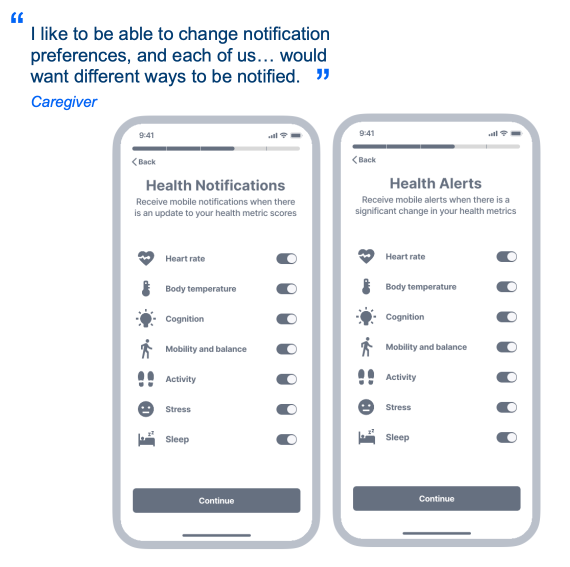
Onboarding and setup - toggling notifications and alerts
Customization
Users are hesitant to commit to notifications because they already receive so many from other apps; however, both caregivers and seniors are open to the idea of notifications as long as they can be fully customized.
Data trust
Both caregivers and seniors expressed that in order to receive alerts or notifications, they must feel that the data being presented is trustworthy and accurate or they may stop engaging all together.
Key Insights
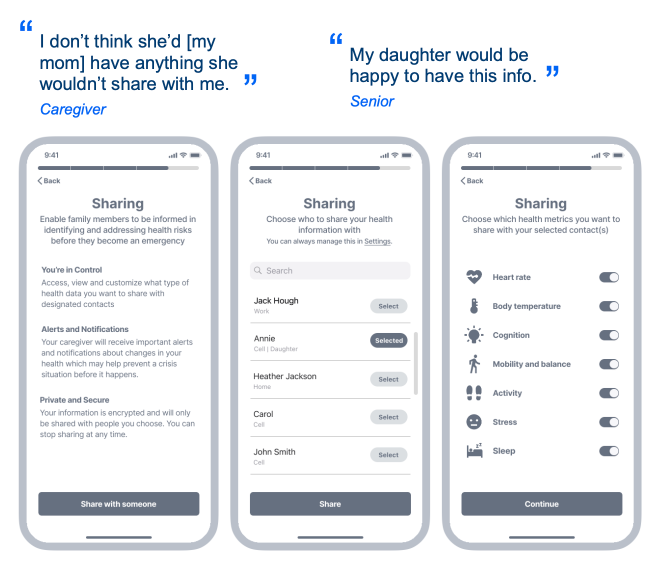
Onboarding and setup - sharing biometric data with a caregiver
Share with multiple contacts
Seniors and caregivers want the ability to share with multiple family members and be able to customize which biometrics they share with specific contacts.
Caregiver trust
Caregivers feel their relationship with their senior is open enough that sharing all the biometrics will not be an issue.
Access control
Caregivers would like to have access to all the senior’s biometrics and the ability to turn them off/on later in settings; similarly, seniors are interested in sharing their biometrics with their caregivers but want control over which metrics are shared.
Key Insights
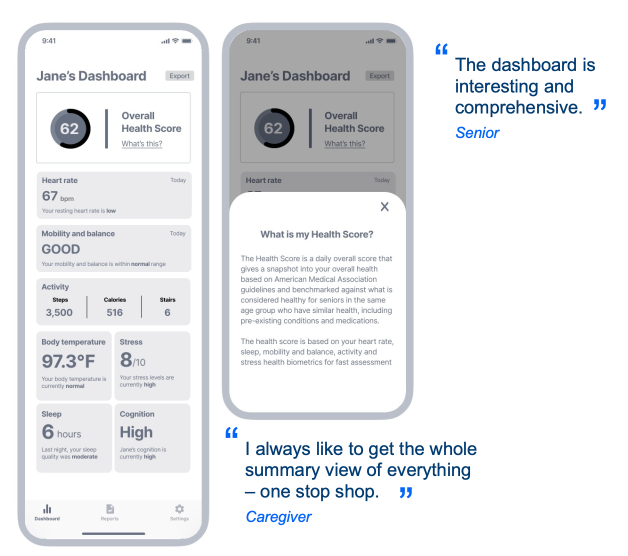
Dashboard - viewing trends and insights
Health score
Some users said the score might be taken lightly, especially if they didn’t understand what it was or how it was being measured.
Trends
Being able to see data over time for each biometric is important for understanding current state and where improvements can be made or when concerns/abnormalities begin to happen.
Insights
Being provided with additional context to the graphical data is helpful.
Engagement frequency
If there were certain events happening frequently, data would be monitored more often by users; if senior’s health is going well, users may check the data more periodically.
Key Insights
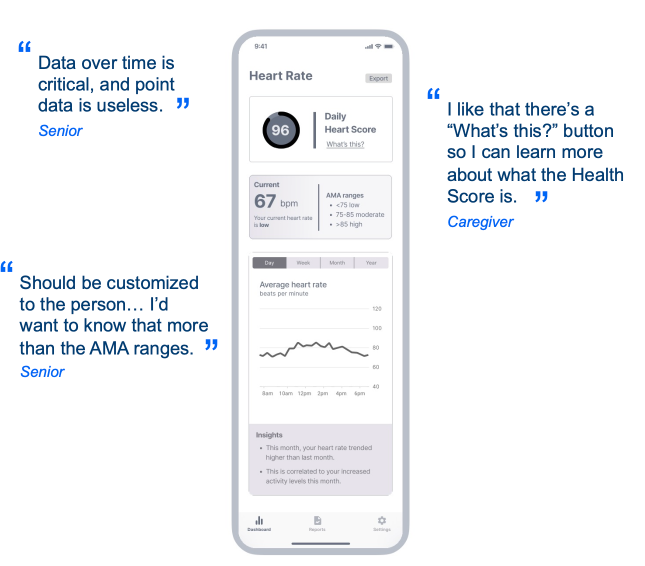
Dashboard detailed metric view - viewing a specific biometric’s trends and insights
Clinical (American Medical Association) guidelines
Would be most desirable if it was personalized to the user.
Factual information
Having the data from the app allows for facts to be presented instead of emotions when hard conversations need to happen around the senior’s health.
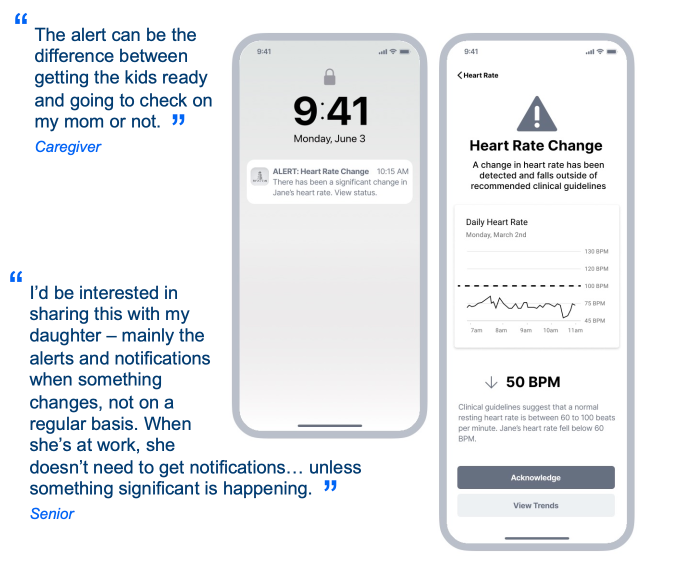
Key Insights
Alerts - receiving an alert when severe deviations in metrics detected
Data accuracy
It will be important for the data to be accurate, trustworthy, and personalized so users do not become numb to alerts over time.
Alert anxiety
Alerts can induce certain panic states especially for people with dementia or anxiety.
Receiving alerts
Seniors liked the idea of being alerted to a major change in their health (especially for the heart rate biometric).
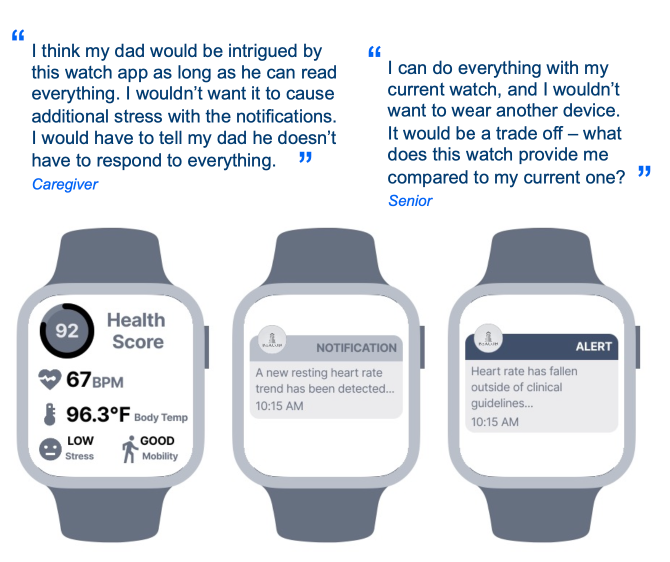
Key Insights
Wearable interface - gathering biometric data via a smartwatch
Watch: senior point-of-view
Seniors like the idea of a watch as a wearable; some seniors currently wear watches to track and view similar biometrics.
Watch: caregiver point-of-view
Most caregivers feel if they guided and encourage their senior to wear a smartwatch, they probably would.
Current watch use
There would likely be higher purchase and engagement rates if the service was integrated into seniors’ current watches of choice (e.g., Apple, Samsung, Fitbit).
Wearables
Some caregivers expressed concerned their seniors with dementia would not wear any form of wearables that they could actively feel.
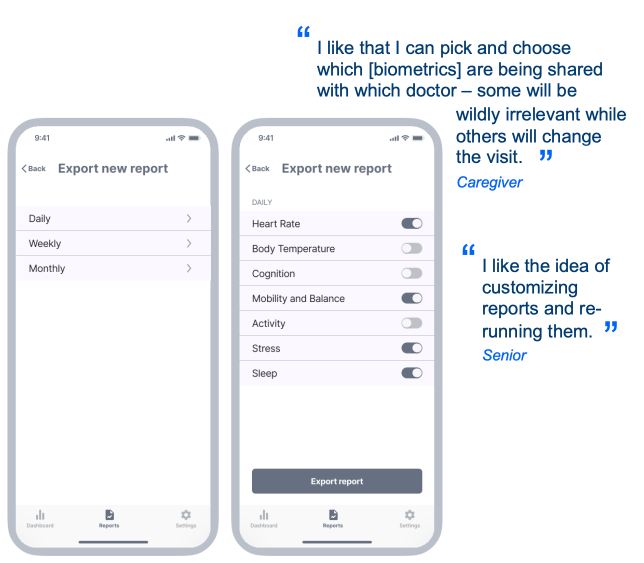
Key Insights
Reports - customizing, exporting and sharing a PDF report
Doctor appointment
Caregivers can imagine themselves taking the report to a senior’s doctor’s appointment.
On-demand
A customizable and “on-demand” report is desirable.
Report frequency
Weekly and Monthly reports are more desirable than daily reports.
Feature enhancement suggestions
Users expressed interest in the ability to input anecdotal notes into the app to remember why certain things happened on certain days, such as when a medication started. Users also expressed interest in a medication log/tracker.
Pricing: Desire to purchase
One of the main asks from the product management team was to discover what a senior and caregiver would pay for this type of product. After gathering reactions to the wireframes, we asked interviewees how likely they would be to purchase a concept like this.
Key insights: Senior
Likely to very likely to purchase
Seniors are likely to purchase the product as long as it provides a clear enhancement to their current wearables and health applications; seniors said they’d likely purchase it for themselves.
Free trial and subscription
There is a general interest for a free trial. A monthly subscription is desirable so they can control if and when they wanted to cancel.
Price
Desired price was $10-$20/month for the app subscription. Desired price for the watch was about $100-$200, and seniors expressed it would be great if the watch was included with the overall subscription. Expressed interest in possible discounts (e.g., for AARP members) or being included with an insurance plan.
Key insights: Caregiver
Very likely to purchase
Caregivers believe this senior alert service is something they would purchase for their senior.
Competitors
Caregivers expressed that the desired price of the product depends on the price of comparable apps/wearables available in the market.
Price
Desired price was $10-$30/month for the app subscription. Desired price for the watch was about $100-$200, and caregivers expressed it would be great if the watch was included with the overall subscription ($200 total).
Additional research insights
Based on our interview synthesis, we further defined the value proposition and opportunities for this concept:
Enhances senior’s existing health habits
Some seniors leverage technology to remain in-tune with their health (basic metrics such as heart rate, step count).
Some seniors embrace technology as a way to stay entertained and informed.
Beacon has the opportunity to enhance the habits and routines seniors have already established in order to help them better manage their health.
Helps seniors transition from a ‘pure caregiver’ role to a ‘senior + caregiver’ role to a ‘pure senior’ role
As time progresses, caregivers first transition into a senior role while maintaining their caregiver responsibilities for older family members; then, as time continues to progress, they begin to lose their caretaker responsibilities and instead transition into a solely senior role.
Helps seniors and their caregivers predict that tomorrow might look like
Seniors and caregivers alike expressed that health issues/conditions may pop up on a day-to-day basis.
This concept has the opportunity to help seniors and their caregivers predict how the senior might be feeling each day, which will give seniors and caregivers the ability to better plan each day.
Helps caregivers manage their ecosystem of health
Caregivers care for the health of people in their lives beyond seniors (e.g., spouses, children, grandparents, their own health).
This concept has the opportunity to help caregivers manage the health of those in their lives, specifically seniors; by helping caregivers manage their senior's health, they can dedicate more energy and mental space to others in their lives (in addition to the senior).
Serves as a one-stop-shop for managing senior’s day-to-day health metrics
Seniors and caregivers alike expressed the many tools they leverage to track and manage the senior's health.
This concept has the opportunity to be the tool that caregivers and seniors use to track all desired health metrics, rather than seniors and caregivers leveraging multiple tools (e.g., multiple wearables and multiple apps).
Next steps and recommendations
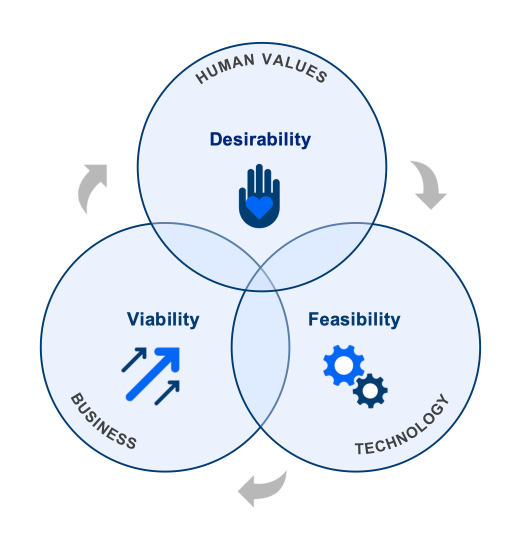
Next steps involve continuing within the virtuous cycle of innovation through a Human Centered Design approach:
Desirability
We recommend that the product team create a Market Requirements Document (MRD) that describes the overall market opportunity so that customers’ needs and desires can be succinctly explained. An MRD involves exploring and defining a/an: executive summary, vision, target market, personas, competitor analysis, high-level capabilities, and metrics strategy.
We recommend that the product team use the Business Model Canvas (BMC) to explore and define the pieces of the BMC that relate to desirability: consumer segments, consumer relationships, channels, and value proposition.
We recommend that the product team update the Press Release and FAQ (PRFAQ) document with findings from this project.
Feasibility
What is technically and organizationally possible to create? Does our company have the people, processes and technology to make this dream a reality?
We recommend exploring the Product Requirements Document (PRD). A PRD describes the requirements for a product and helps the development team understand what the product does; a PRD communicates what is being built, who the product is for, and how it delivers value to users and the business. A PRD involves exploring and defining a/an: overview, objective, context, assumptions, scope, requirements, performance, and open questions.
We recommend exploring and defining the pieces of the Business Model Canvas (BMC) that relate to feasibility: key resources, key activities, and key partners.
Viability
We recommend further defining a Business Requirements Document (BRD). A BRD involves exploring and defining a/an: executive summary, project objectives, project scope, business requirements, key stakeholders, project constraints, and cost-benefit analysis.
We recommend exploring and defining the pieces of the Business Model Canvas (BMC) that relate to viability: cost structure and revenue streams.