An iOS mental health app + provider-facing dashboard designed to improve behavioral health care by giving patients access to more support between visits and offering therapists better tools and information to personalize care.
Project Background
Today, behavioral health treatment is restricted by lack of access to behavioral health providers and lack of the right data to act on. There is a national shortage of both masters level providers and psychiatrists needed for behavioral health treatment. As a result primary care providers (PCPs) and other providers leading patient care are often accountable for managing patients behavioral health needs. Without the necessary tools and information (such as completed, accurate GAD-7 and PHQ-9 scores and clear crisis protocols), PCPs report feeling anxious and unprepared to effectively manage behavioral health needs. Health systems and providers are frustrated, concerned and desperate for a solution to address patient behavioral health needs.
The solution
Launch a pilot study that aims to create a system that helps connect the behavioral health team, the primary care team and the patient to improve integrated behavioral health care.
The system is made of 2 main components: 1) a patient-facing mobile application that utilizes conversational AI to help patients manage mild to moderate anxiety in between visits with their provider and 2) a provider-facing dashboard that displays collected information from the mobile application to help track patient's’ status and guide treatment.
The initial study would involve approximately three therapists and thirty patients for the duration of the patients’ short-term therapy (12-16 weeks). To be eligible for the study, patients must be referred to Behavioral Health by a PCP, have mild to moderate depression/anxiety according to PHQ-9 or GAD-7 scores, have an iPhone, and be willing to see a therapist for short-term therapy every 2 weeks.
The patient experience: an iOS mobile app
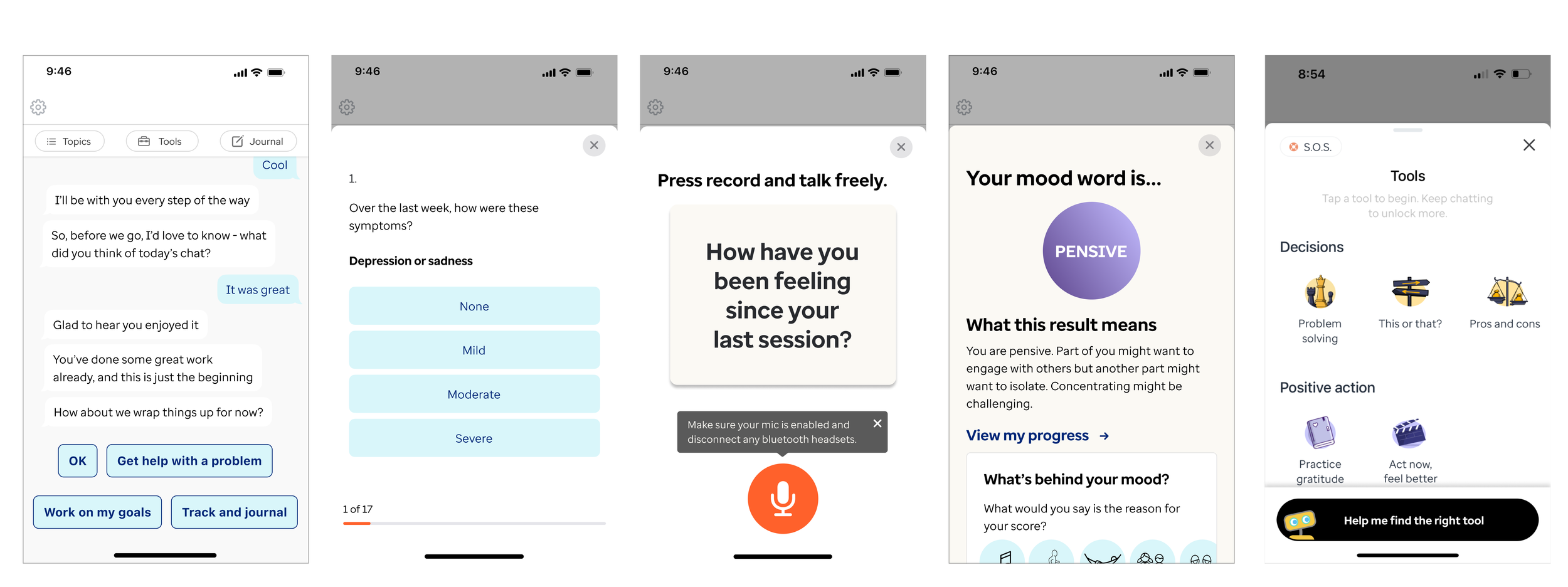
I worked with a team of four UX designers, engineers, marketing managers, clinical researchers and product owners to create the patient experience by designing a set of iOS screens that would launch in Apple’s App Store.
Throughout the study, patients were asked to interact with the app for 5-10 minutes per day, 5 days a week at a minimum. The app features a suite of capabilities for patients including:
A relational agent (chatbot) that uses evidence-based principles of psychotherapy, such as Cognitive Behavioral Therapy (CBT) to help patients work on their goals and impact how they think, feel and behave
Psychoeducational content
Self-help skills like breathwork and guided meditation
Journaling, including mood tracking
Voice check-ins that track the severity of depression and anxiety and help inform care
Patient reported outcomes (PROs) such as PHQ-9 and GAD-7 questionnaires
The therapist experience: a provider-facing dashboard
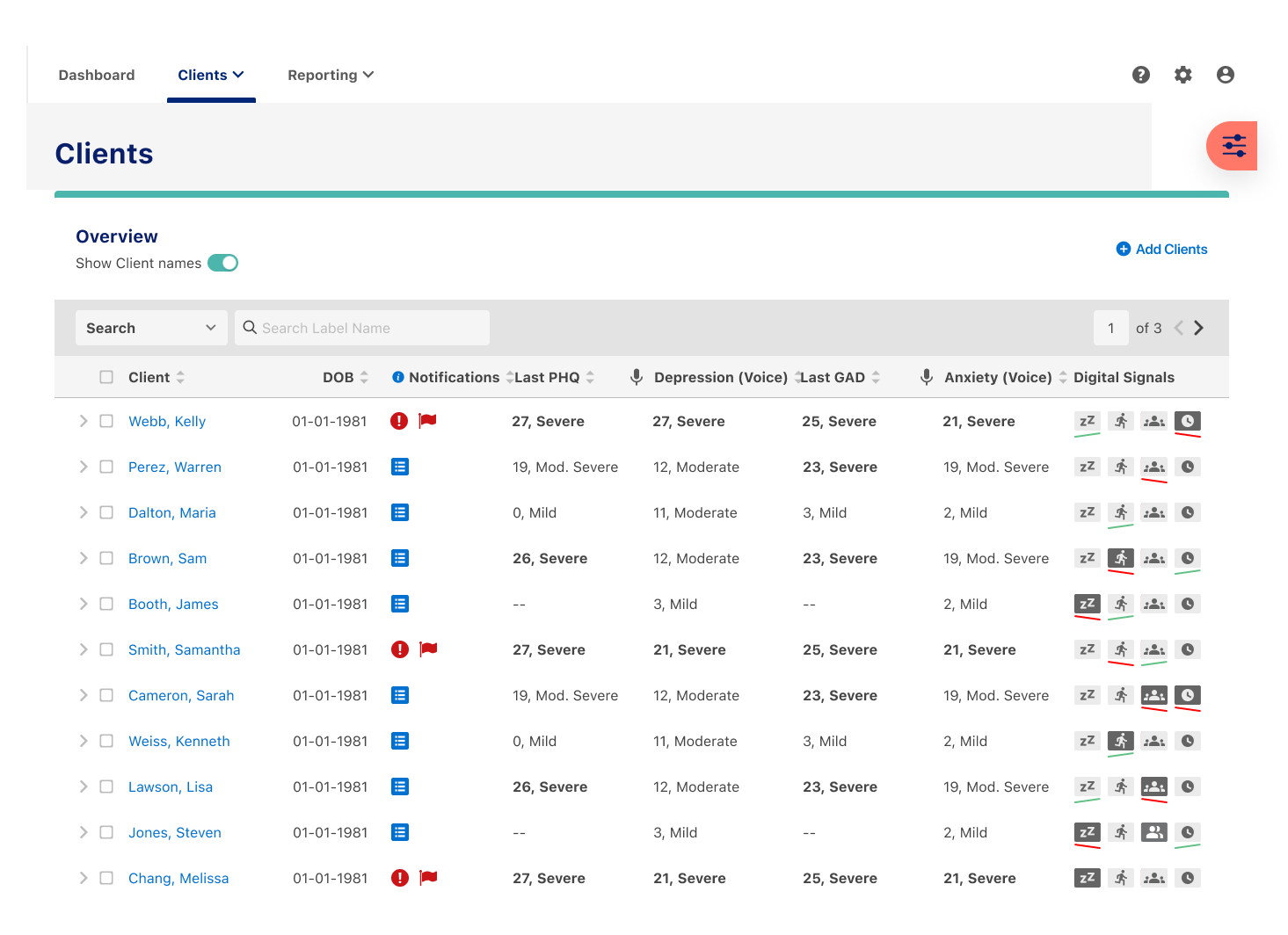
As the patient continues to use the mobile application, data is sent to the therapist where it is displayed in a dashboard. During the study, the therapist was asked to monitor the dashboard prior to every appointment with the patients. The information was used to help the therapist better understand what treatment options to provide during the therapy sessions and to be better informed of their patients status in-between visits.
The dashboard displays the following patient data:
The patients’ most recently reported PHQ-9 and GAD-7 scores
Voice check-in scores
Digital signals - if the patient consented to the mobile application tracking digital signals such as location and activity, it will be displayed in the “Digital Signals” column
Impact on the healthcare system
In the US, per capita healthcare spend is $12,350, and patients with anxiety or depression and a chronic condition are forecasted to spend 200-400% of that.
Total medical spend among patients with a chronic condition (such as hypertension or diabetes) and a mental health need is estimated to be $350-700B for 13.8M people. If this solution can reduce healthcare spend by 15%, that accounts for a savings of $315-630 cost per member per month.
Increasing access to behavioral health services through a solution like this has the estimated potential to reduce medical spend by $3.5k-7k per patient per year.
Product success metrics
Launching a pilot program will allow us to gather more metrics and further evaluate the product idea. Additional data can be gathered through qualitative interviews and usability testing to further inform iterations and of the product.
Clinical efficacy
% change in depression/anxiety scores
duration of patient treatment
inpatient utilization and duration
Patient adoption
Referral rate among patients with a behavioral health need
Referral to adoption (login) conversation rate
Average session duration in the mobile application
Graduation rate from the pilot program
Reduced anxiety/depression scores after program completion
Patient experience and provider experience
NPS score
Provider adoption
% of PCPs and behavioral health providers with access who refer more than one patient
Referral rate among patients with a behavioral health need
Financial
Enrolled patients’ medical spend